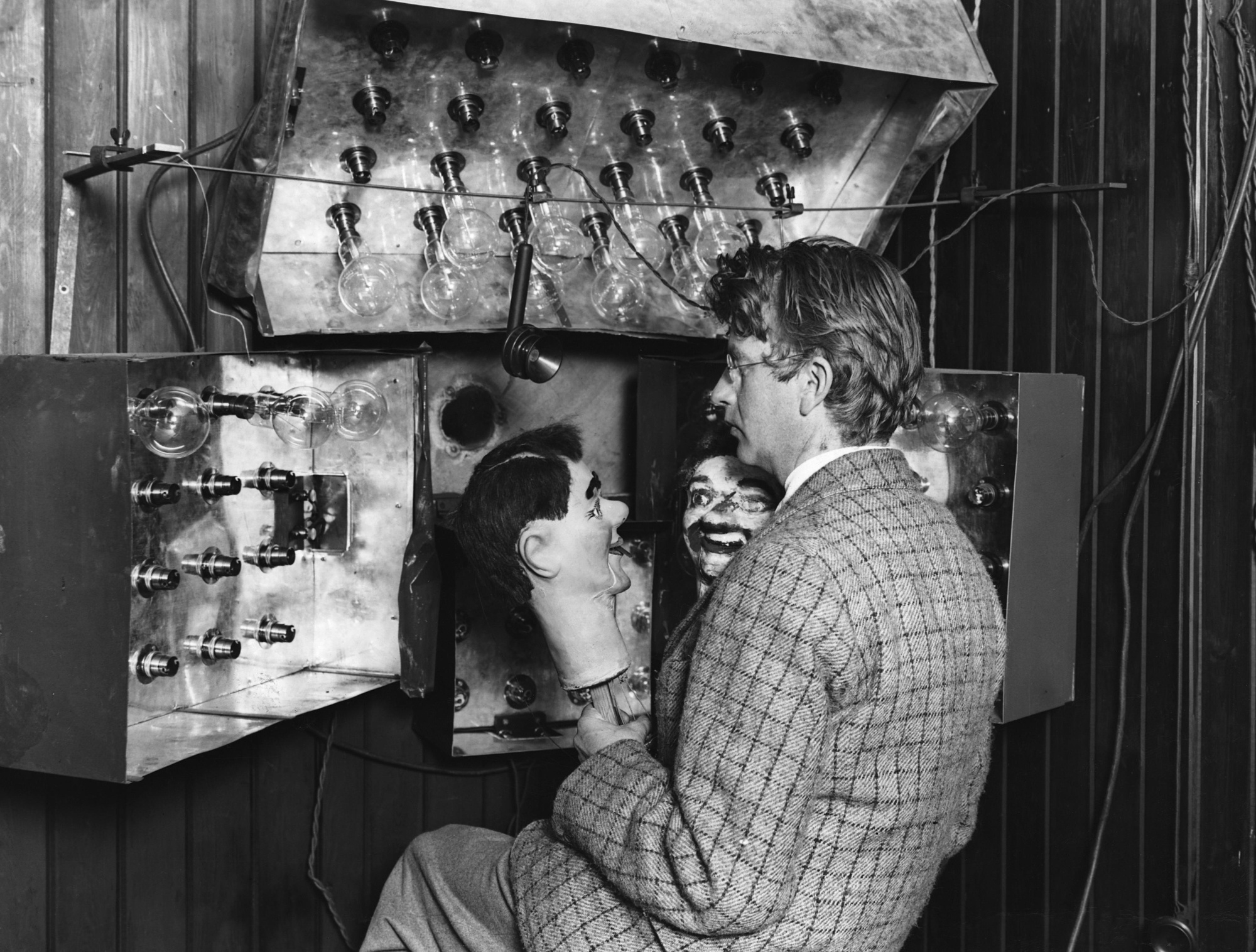
A hundred years ago, visitors to a laboratory in central London became the first people in the world to watch television. Engineer John Logie Baird transmitted a moving image across a room: a ventriloquist’s dummy at one end of the apparatus, a screen at the other. It did not look much like television as we know it. The signal was sent and received through spinning discs, lenses and light.
The first television image
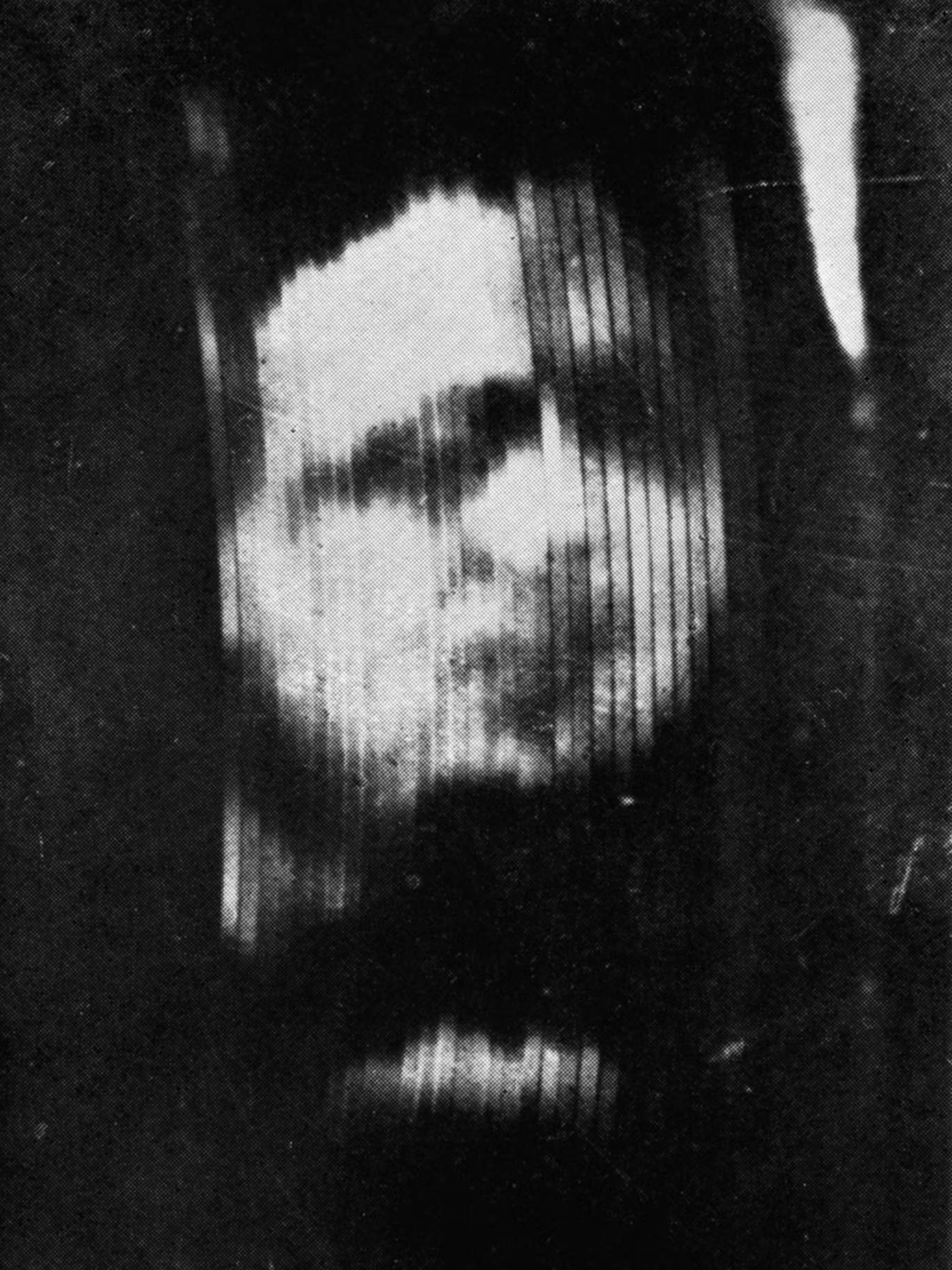
Baird’s idea was to break reflected light into a sequence of separate signals using rotating discs. On screen, the result looked like a face: blurry but recognisable.
By all accounts, the journalists who saw it were deeply impressed, despite the poor image quality. The setup itself was almost theatrical: a subject at one end, a receiver at the other, and an image assembled out of light and synchronisation rather than a camera and display in the modern sense.
One photograph from Baird’s experiments survives, giving us something like a screenshot of the first television transmission.
Television before Baird
Baird was not the sole inventor of television. What he built was a working system assembled from ideas developed by others. In 1885, Paul Nipkow patented an “electric telescope”: a rotating disc with holes arranged in a spiral scanned an image line by line. Each strip of the picture became an electrical signal, and at the receiving end, that signal was turned back into light.
Other pieces of the puzzle were already in place. In the 1880s, the French engineer Maurice Leblanc described the basic principles of image transmission. In 1925, the American inventor Charles Jenkins synchronised image and sound, although his system could only show still pictures.
Baird’s leap was practical. He took scattered principles, synchronised them, and pushed them into public view.
How the Televisor worked
Baird’s own machine, called the Televisor, used two Nipkow discs: one in the transmitter and one in the receiver. Each had 30 holes, which meant 30 lines of resolution. The discs spun at about 12.5 revolutions per second, giving roughly 12.5 frames per second. Full HD has 1,080 lines.
The transmitting disc scanned the image bit by bit. At each moment, light from only a small part of the subject passed through the system and reached a photoelectric cell, which converted changes in brightness into an electrical signal. That signal could then be sent through wires or broadcast through the air, like a radio.
At the receiving end, it controlled a neon lamp. Its light passed through a slit and onto another spinning disc, perfectly synchronised with the first. The image appeared on frosted glass, building up dot by dot, almost like pixels.
Why Baird used a dummy
The system had one obvious flaw: it needed an enormous amount of light. The subject had to be illuminated by banks of incandescent bulbs. Standing beside them was unbearably hot and painfully bright. That is why Baird began with a ventriloquist’s dummy rather than a human subject.
Remarkably, no one has managed to rebuild Baird’s earliest setup without modern semiconductor sensors. A working model can be made with 3D-printed parts, LED lamps and Arduino boards, but not with the original components alone.
Baird kept the details of his method secret because he feared competitors. Researchers think he used a selenium photoelectric cell, though some believe he may have worked with thallium sulphide instead.
Video reconstruction
If you want to see what Baird’s broadcasts looked like, there is a good approximation online. The reconstruction of The Man with the Flower in His Mouth, a television play broadcast in July 1930 for Baird-system receivers, survives on YouTube.
In 1963, the producer of the original broadcast recreated it using a restored Televisor and filmed the result with a modern camera.
From shop window to broadcast service
Unlike Nipkow, who never turned his invention into a business, Baird understood television’s commercial potential. The first public demonstration of his system did not take place in January 1926 before scientists and journalists, but a year earlier, for a very different audience. In March 1925, Baird showed his Televisor to shoppers at Selfridges.
That version used discs with 16 holes rather than 30, and the audience saw little more than vague silhouettes. That is why 1926 is usually treated as the true beginning of television. Even so, the instinct was clear. This was not a machine destined to stay in the laboratory.
In 1927, Baird founded Baird Television Development Company, and a year later he carried out the first transatlantic television transmission. From 1929 to 1937, the BBC used his mechanical television system.
Why mechanical television lost
One of the main reasons was the rise of electronic television, developed by Vladimir Zworykin, an American engineer born in the Russian Empire. In 1923, he patented a system built around an electronic camera tube called the iconoscope. Early versions were too insensitive and produced poor images. The breakthrough came in 1929, when Zworykin met David Sarnoff of RCA. Sarnoff gave him funding, a laboratory and a team.
Zworykin then turned the iconoscope into a practical device and, at the same time, developed the kinescope, an electronic display tube. Together, the two made electronic television viable. Compared with mechanical television, this system offered sharper pictures, less flicker, and smaller, more reliable equipment.
At about the same time, Philo Farnsworth was developing a similar system. He and Zworykin later became embroiled in a patent dispute, and RCA eventually had to pay Farnsworth royalties. Baird’s company also tried to move beyond the limits of mechanical television, working with Farnsworth on a hybrid mechanical-electronic system. Meanwhile, EMI partnered with Marconi to develop its own image-transmission technology.
Afterlife
In late 1936, a fire destroyed Baird’s laboratory. In 1937, the BBC dropped his system and switched to the Marconi-EMI system. Baird kept experimenting, including with electronic colour television in the 1940s, after carrying out early colour tests as far back as 1928.
But by then the direction of travel was clear. Television was going to be electronic. Mechanical television remained what it still looks like today: a brilliant, necessary, and ultimately temporary stage in the making of the modern screen.